Course Description
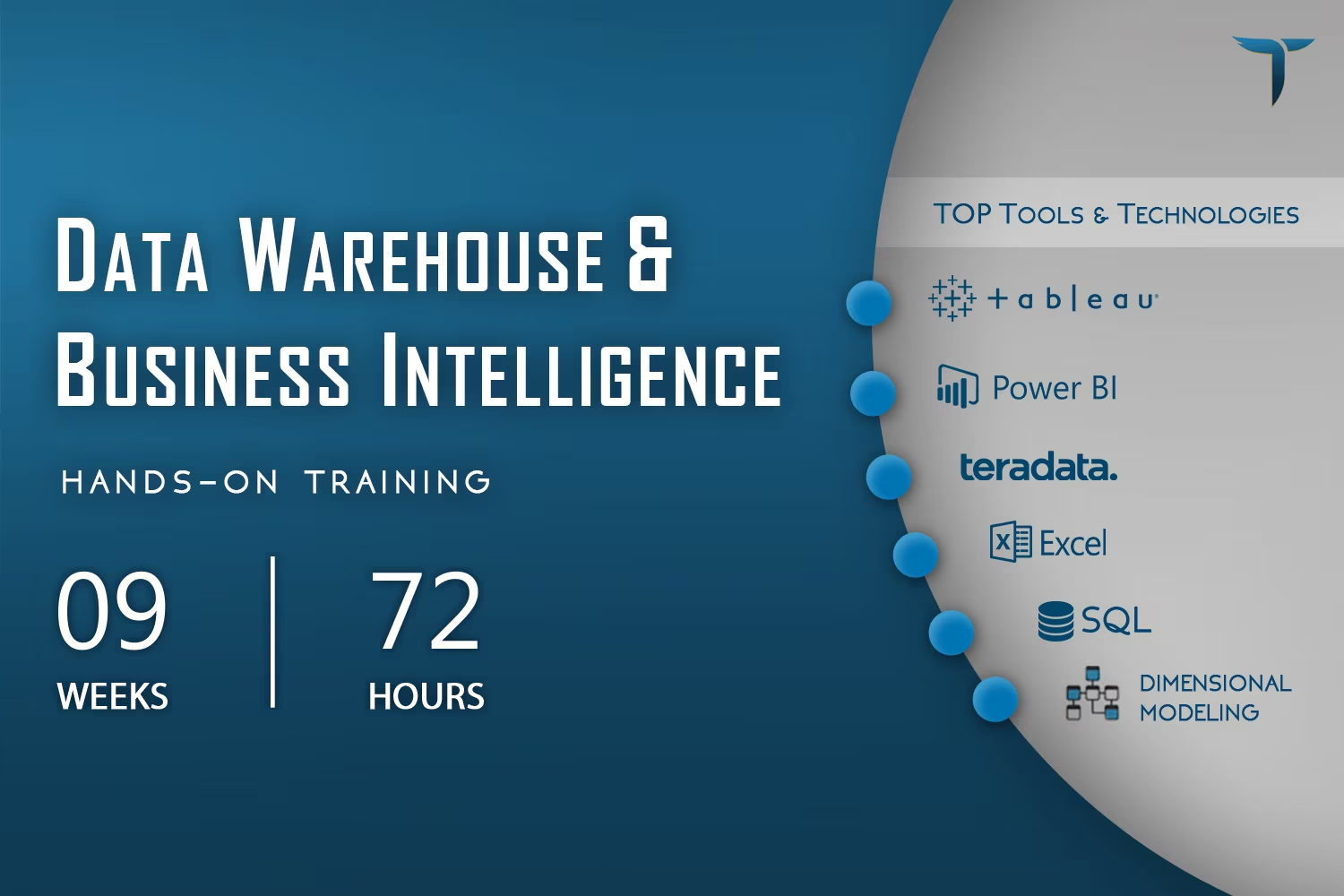
Offering a 9-week hands-on training, enabling students to implement green field implementation of DWH to perform reporting and visualization (BI) for 360-degree corporate profiling using the industry standards. Participants will master data warehousing using SQL, Power BI, and Tableau for analysis and reporting after completing all phases comprising of business analyst, data modeler, ETL developer and BI expert.
What You’ll Learn From This Course
- The fundamental concepts and principles of data warehousing, including the differences between OLTP (online transaction processing) and OLAP (online analytical processing) systems.
- The architecture of a data warehouse, including the various components and their functions, such as ETL (extract, transform, load) processes, data modeling, and data integration.
- How to design and implement a data warehouse, including identifying data sources, defining a data model, and designing the ETL process.
- How to master ETL (extract, transform, load) processes, including identifying source systems, mapping data to the data warehouse model, and implementing transformations.
- How to use BI (business intelligence) data modeling techniques to design and build a data warehouse schema, including normalization, dimensions, fact tables, and hierarchies.
- How to use Excel and Power BI to analyze and visualize data from a data warehouse, including creating pivot tables, charts, and graphs.
- How to use Power BI to create interactive dashboards and visualizations, including designing layouts, selecting appropriate visualizations, and applying filters and slicers.
- How to use data warehousing best practices, such as data quality management, data governance, and data security.
- How to manage and maintain a data warehouse, including monitoring performance, ensuring scalability, and performing backups and recovery.
Introduction to Data Warehouse & Business Intelligence
 Introduction to Data Warehouse & BI
- Importance of a Data Warehouse & its applications
- Introduction to Data Warehouse core concepts
- Transactional databases vs. Data Warehouses
- Databases vs. RDBMS & its types
- Business Intelligence vs. Data Science vs. Data Engineering
- Normalization vs. Denormalization
- Introduction to Teradata TTUs
- VM & required SW Installations
- Introduction to SQL – Query language for Data Warehouse
- DDL vs. DML vs. DCL
- Creating Databases, Tables & defining attributes
- BTEQs & Table types – Set vs Multiset
- Views / Materialized views
By the end of this course, the candidate should have a basic understanding of DWH Essentials & SQL
Mastering SQL & Project Kick-off
- Stored Procedures & Functions
- Indexing & Constraints
- Aggregate functions, Window aggregate functions, Order analytical functions
- SQL Ad-hoc reporting & analysis
- Business Discovery for DWH – Project Kickoff
By the end of this course, the candidate should have a Mastering SQL & Project Kick-off
Data warehouse Framework & Design
- Data Warehousing Structure Fundamentals
- Conceptual vs Logical vs Physical Data Model
- Introduction to Teradata’s HW Architecture
- Indexing – Primary Index vs. Primary Key
- Partitions & Data Storage – Hashing Algorithms
- Data Retention & Compressions
- Data Modelling & Schema design
- Introduction to ETL / ELT (Extract, Load & Transform)
- Star vs Snowflake vs Galaxy Constellation
- Data loading into staging layer – Readiness for Functional layer
By the end of this course, the candidate should have a basic understanding of Data warehouse Framework & Design
ETL Pipeline & Data Warehouse Building Blocks
- Implement data quality checks
- Implementation of Normalization – 3NF
- Apply transformations & develop functional layer
- Hands on with physical Data Model (Foundation layer)
- Hands on with Physical Data Model (Aggregate layer)
- Building Reconciliation Mechanism across layers of DWH Performance Monitoring & Automation
- ETL Automations using SLJM
- Performance Tuning
- Statistics
- Data Quality & Automations
- Viewpoint Query Monitoring, Health Monitoring, Workload Management, Query Spotlight
- Learning importance of Explain Plan & query Performance Optimization
By the end of this course, the candidate should have a basic understanding of ETL Pipeline & Data Warehouse Building Blocks
BI Data Modelling
- Business Intelligence & its importance
- OLAP – Dimensional Modelling Fundamentals
- Dimensional Modelling Design with industrial use case
- Build & deploy Semantic layer
- Design Steps – Kimball’s Dimensional Modeling (Hands on)
- Implementation – Kimball’s Dimensional Modeling (Hands on)
- Managing DWH history through Slowly Changing Dimensions (SCDs) with use cases
- ROLAP vs MOLAP vs HOLAP
- Design & implementation of Kimball’s Dimensional Model technique – Semantic layer Readiness
By the end of this course, the candidate should have a basic understanding of BI Data Modelling
Microsoft Excel
- Loading, Cleaning & Preparing data
- Managing the Data Model
- Pivot Table for Data Analysis
- Lookup Functions, Aggregate Functions & Merging techniques
- Data Analysis using Charts & Visualizations
Microsoft Power BI
- Connect & Get Data from multiple Data sources
- Data Connection/Storage modes – Import, Live, Direct Query & Dual
- Reshaping and Transforming Data in Query Editor
- Data Enrichment (New business Fields)
- Data Modelling
- Understanding Cardinalities
- Understanding Filter Context
- Building Interactive Visualizations on implemented Dimensional Model
- Animated Visualization Implementation
- Roll-up/Roll-Down Capabilities
- Introduction to DAX Language
- Custom visualization in Power BI
- Creating DAX Measures
- Evaluating DAX Measures
- Leverage Calculate Functions functionality
- Time Intelligence – MTD, QTD and YTD Date Calculations
- Introduction to Power BI Services
- Scheduling Automated Reports Refresh
- Sharing Reports & Dashboards
- Mobile Dashboard Design
- Performance monitoring & debugging a slow running report – DAX Studio
- Business Use Case implementation in Power BI (Assignment)
By the end of this course, the candidate should have a basic understanding of BI Reporting & Analysis
Visualization & Business Analysis
- Connecting with Different Data Sources in Tableau
- Data preparation with Tableau
- Live Vs Extract
- Data Source Filters
- Basic Report Creation
- Understanding of Rows and Columns
- Leveraging the Use of Marks Labels to enrich information in Reports
- Visualization best practices with real world examples
- Grouping fields in Tableau
- Interactive Filters
- Types of filters
- Advanced Filter Calculations
- Enhancing user interactivity thorough parameters
- Pages
- Maps in Tableau
- Importing custom geocoding in Tableau
- Visualize your data on map through spatial files
- Building a Dashboard
- Leveraging the use of Interactivity in Dashboards through Actions
- Designing and implementation of dashboard
- Designing of dashboard for mobile & Tablets
- Extensions
- Enriching information by creating Calculated Fields
- Calculation Syntax
- Date/Logic/String Calculations
- Advance Calculations (LODs)
- LODs & real-world Use cases
- Visual analytics
- 80-20 rule – Pareto Chart
- Business Use Case implementation in Tableau (Assignment)
- Career counseling & Final Assessment

Nouman Mir

DATA ANALYTICS EXPERT
Nauman has 13 years of experience in Analytics across many industries. His major expertise are in DWH, BI, Big Data and Contextual Marketing. He has been following his passion to train individuals and corporates for the last 7 years, locally and internationally.

Saba Farooqi
ASSOCIATE PRACTICE MANAGER, BUSINESS INTELLIGENCE AT TERADATA
Saba Farooqi has over 13 years of extensive experience in Business Intelligence & Data warehousing solutions with focus on access layer design and foundation layout. She has managed teams and created benchmarks in semantic data modeling in telecom sector of Pakistan apart from ensuring on time delivery of programs & projects as product owner. With an emphasis on effective communication with stakeholders, she has expounded complex business objectives and product requirements to develop consensus over solutions and ensured customer satisfaction.

Yasir Mehmood
BUSINESS INTELLIGENCE CONSULTANT AT TERADATA
A Computer Science graduate by qualification and a developing data enthusiast by choice, holds over 7 years of industry experience in the field of technology, data analytics, data warehousing, EL/TL, data mining, reporting & visualization. My qualifications & my actual job in the field of Business Intelligence & Data Warehousing have provided me with a well-rounded background and enabled to develop an analytical/logical approach to tasks, software skills and ability to work under pressure.
 Duration
 Timings
 Hours
Hours Instructor
 Already Registered? Proceed directly to payment